

Focusing on the intricate relationship between weapon systems and political stability, this posthumous manuscript by historian Carroll Quigley offers a comprehensive analysis grounded in his anthropological approach to history. After being largely inaccessible for over 30 years, the unabridged work presents Quigley's insights, building upon the themes explored in his earlier influential texts, "Tragedy and Hope" and "The Evolution of Civilizations." This publication invites readers to engage with Quigley's unique perspective on historical dynamics.
Carroll Quigley Volgorde van de boeken (chronologisch)
Deze Amerikaanse historicus en theoreticus onderzoekt de evolutie van beschavingen. Hij staat bekend om zijn onderwijs aan de Georgetown University, zijn academische publicaties en zijn onderzoek naar geheime genootschappen. Eerder doceerde hij aan Princeton en Harvard en adviseerde hij overheidsinstanties zoals het Amerikaanse Ministerie van Defensie. Zijn werk duikt diep in de ontwikkeling en structuren van samenlevingen.


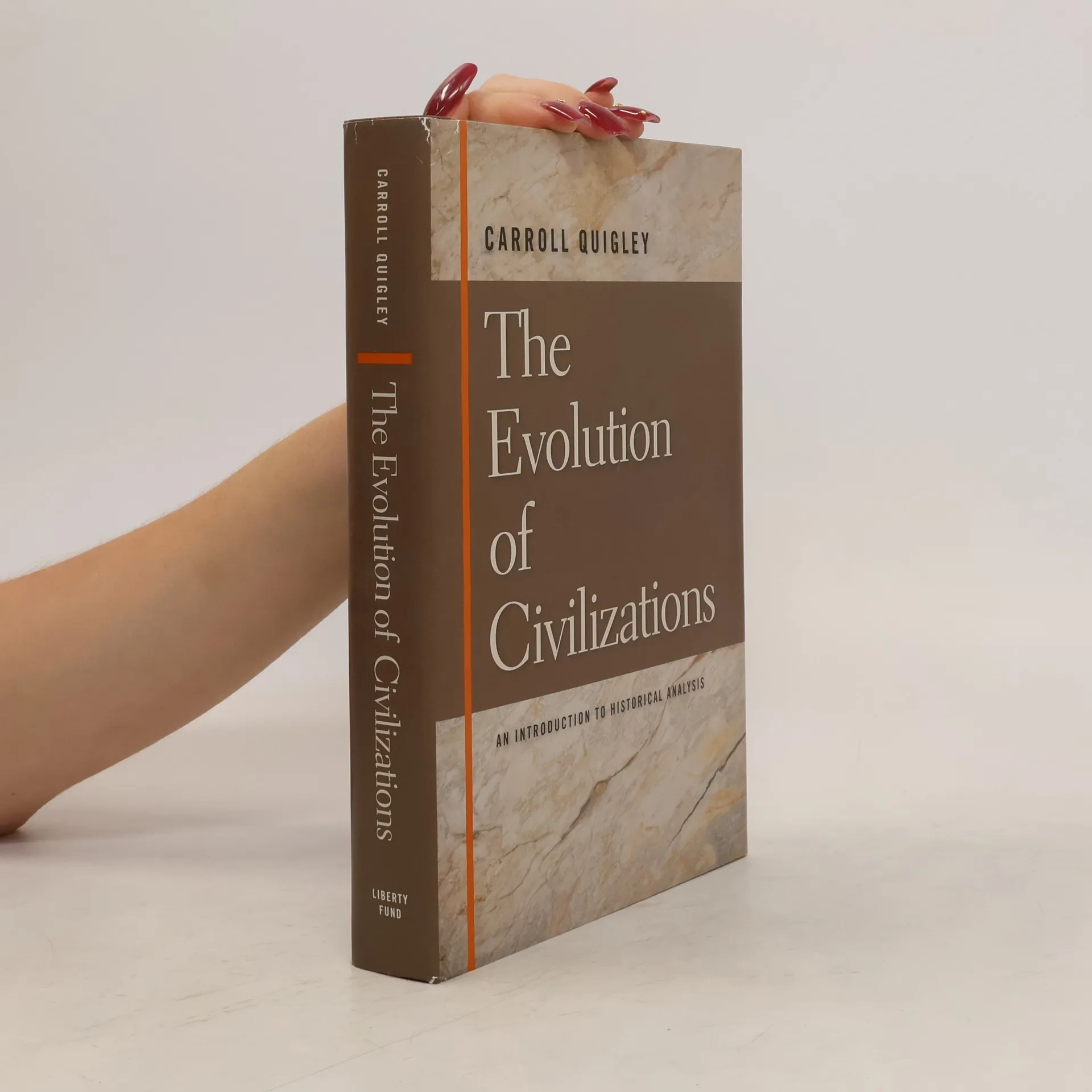

Carroll Quigley was a legendary teacher at the Georgetown School of Foreign Service. His course on the history of civilization was extraordinary in its scope and in its impact on students. Like the course, The Evolution of Civilizations is a comprehensive and perceptive look at the factors behind the rise and fall of civilizations. Quigley examines the application of scientific method to the social sciences, then establishes his historical hypotheses. He poses a division of culture into six levels from the abstract to the more concrete. He then tests those hypotheses by a detailed analysis of five major civilizations: the Mesopotamian, the Canaanite, the Minoan, the classical, and the Western. Quigley defines a civilization as "a producing society with an instrument of expansion." A civilization's decline is not inevitable but occurs when its instrument of expansion is transformed into an institution--that is, when social arrangements that meet real social needs are transformed into social institutions serving their own purposes regardless of real social needs.
TRAGEDY AND HOPE shows the years 1895-1950 as a period of transition from the world dominated by Europe in the nineteenth century to the world of three blocs in the twentieth century. With clarity, perspective, and cumulative impact, Professor Quigley examines the nature of that transition through two world wars and a worldwide economic depression. As an interpretative historian, he tries to show each event in the full complexity of its historical context. The result is a unique work, notable in several ways. It gives a picture of the world in terms of the influence of different cultures and outlooks upon each other; it shows, more completely than in any similar work, the influence of science and technology on human life; and it explains, with unprecedented clarity, how the intricate financial and commercial patterns of the West prior to 1914 influenced the development of today's world.