Bookbot

A. N. Kolmogorov

    Andrej Nikolajevitsj Kolmogorov was een Sovjet-wiskundige en professor aan de Staatsuniversiteit van Moskou, waar hij de eerste voorzitter van de afdeling waarschijnlijkheidstheorie werd. Zijn werk legde de moderne axiomatische grondslagen van het vakgebied en beïnvloedde de verdere ontwikkeling ervan diepgaand. Kolmogorov's impact op de wiskunde is onmiskenbaar, en zijn benadering van waarschijnlijkheid blijft een hoeksteen van de studie.

    Mathematics of the 19th Century
    Foundations of the Theory of Probability: Second English
    Mathematics of the 19th Century
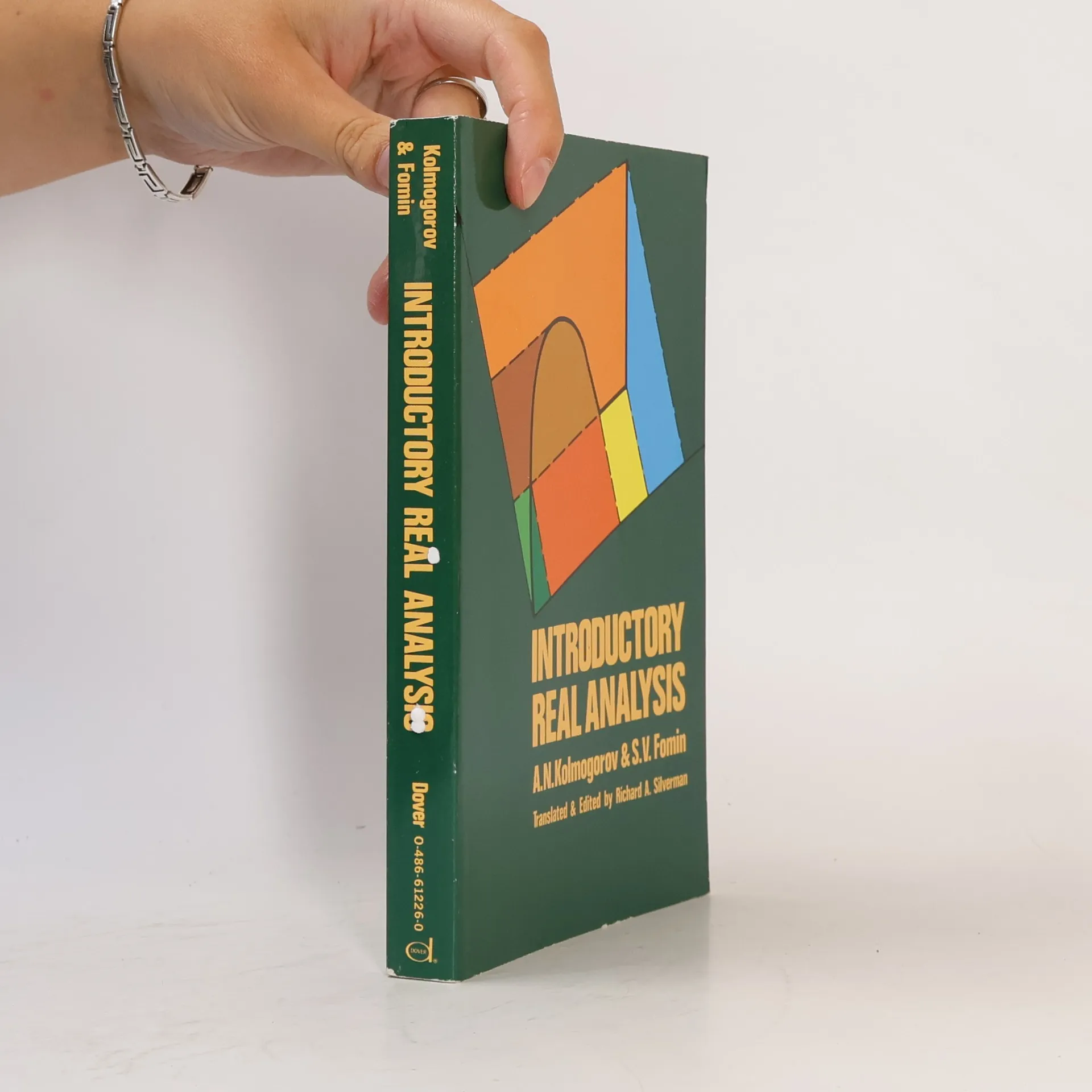
    Introductory Real Analysis
    Foundations of the Theory of Probability
    Elements of the Theory of Functions and Functional Analysis [Two Volumes in One]
    • Focusing on advanced mathematical concepts, this comprehensive two-part text by A. N. Kolmogorov covers essential topics such as metric and normed spaces, measure theory, and Hilbert space. The work reflects Kolmogorov's significant contributions to various fields, including probability theory and turbulence. It includes exercises for practical application and provides lists of symbols, definitions, and theorems, making it a valuable resource for advanced students and researchers in mathematics. The reprint preserves the original edition's integrity without optical recognition software.
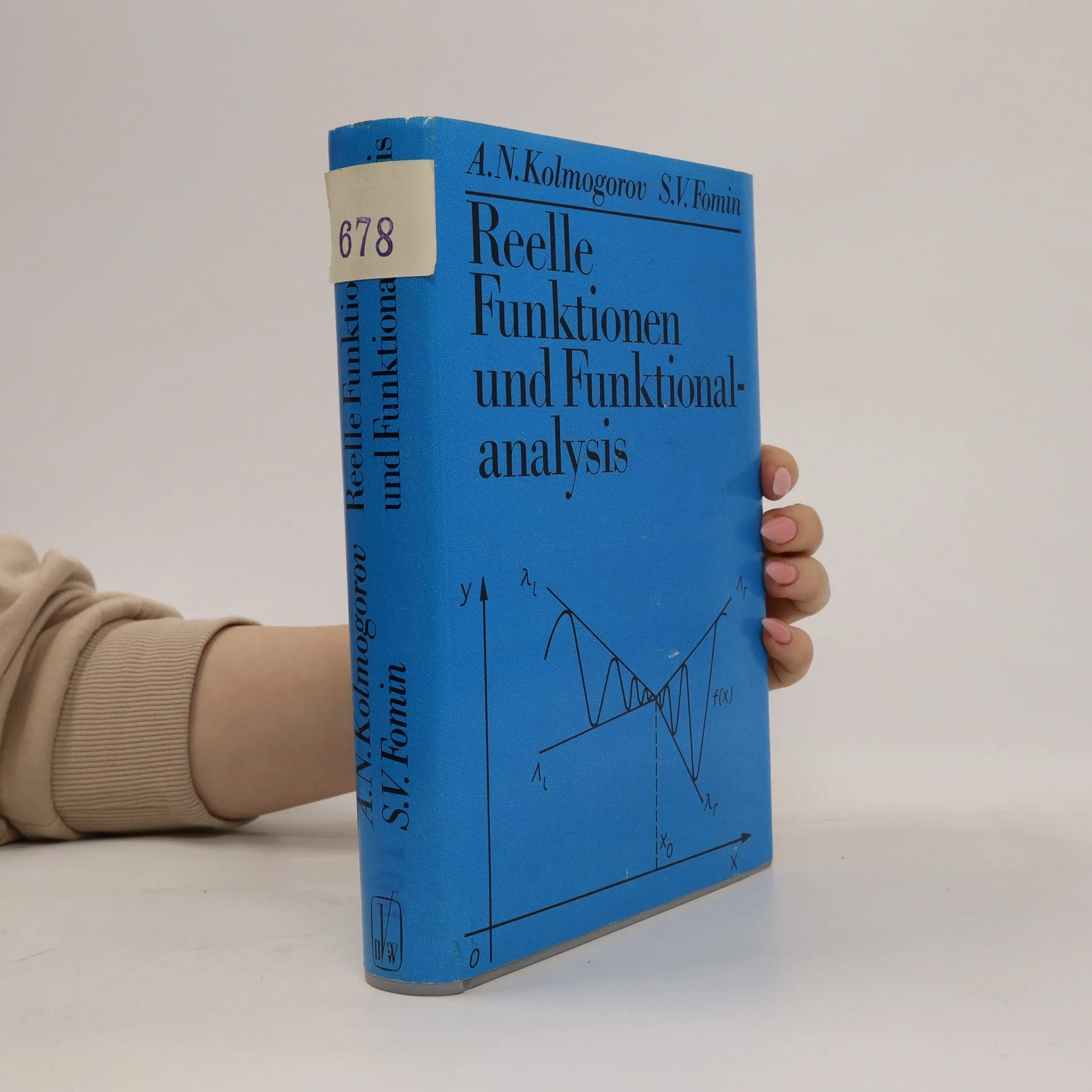

      Elements of the Theory of Functions and Functional Analysis [Two Volumes in One]
      4,5
    • This foundational work in probability theory rigorously establishes key principles, akin to Euclid's approach to geometry. Originally published in 1933, it marked a significant milestone in mathematics, laying the groundwork for modern probability. Kolmogorov's treatise not only introduced essential concepts but also solidified his status as a preeminent figure in the field. This reprint offers a full facsimile of the original edition, preserving the historical significance and intellectual contributions of Kolmogorov's groundbreaking insights.

      Foundations of the Theory of Probability
      4,3
    • Comprehensive, elementary introduction to real and functional analysis covers basic concepts and introductory principles in set theory, metric spaces, topological and linear spaces, linear functionals and linear operators, more. 1970 edition.

      Introductory Real Analysis
      4,2
    • Mathematics of the 19th Century

      Function Theory According to Chebyshev Ordinary Differential Equations Calculus of Variations Theory of Finite Differences

      • 372bladzijden
      • 14 uur lezen

      The editors initially aimed to create a comprehensive work on the history of nineteenth-century mathematics, transitioning systematically through various disciplines. However, challenges in author selection led to the abandonment of this plan by the second volume. Instead of a unified monograph, the series now offers a collection of books that collectively cover the mathematics of the nineteenth century, though not in the conventional order of disciplines. Unlike the first two volumes, which were organized into chapters, this third volume is divided into four parts, aligning better with the publication's nature. The first book addressed the history of mathematical logic, algebra, number theory, and probability, while the second focused on geometry and analytic function theory. In this third volume, readers will encounter an essay on Chebyshev's theory of function approximation, later termed "constructive function theory" by S. N. Bernshtein. This original essay, authored by the late N. I. Akhiezer (1901-1980), who made significant contributions to this field, is expected to engage not only historians of mathematics but also specialists in constructive function theory.

      Mathematics of the 19th Century
      3,5
    • This famous little book remains a foundational text for the understanding of probability theory, important both to students beginning a serious study of probability and to historians of modern mathematics. 1956 second edition.

      Foundations of the Theory of Probability: Second English
      3,9
    • Mathematics of the 19th Century

      mathematical logic, algebra, number theory, probability theory

      • 308bladzijden
      • 11 uur lezen

      This multi-authored work is a continuation of the History of Mathematics from antiquity to the early nineteenth century, which was published in three volumes from 1970 to 1972. The discussion of twentieth-century mathematics concludes in the 1930s. Our objectives mirror those stated in the preface to the earlier edition, viewing the development of mathematics not just as a refinement of concepts and techniques for understanding spatial forms and quantitative relationships, but also as a social process. Established mathematical structures can evolve autonomously, yet their development is ultimately influenced by practical activities and societal needs. We aim to explore the forces shaping mathematical progress, focusing on the interplay between mathematics and social structures, technology, natural sciences, and philosophy. Through an analysis of mathematical history, we seek to clarify the interconnections among various mathematical disciplines and assess achievements in light of the current state and future of the field. The challenges we face in this endeavor are significantly greater than those encountered in the preparation of the previous three-volume edition.

      Mathematics of the 19th Century