
Words are aspects of a much wider communicative context, most of which is not verbal at all. Yet words also have a nature peculiarly their own. And when discussing them as modes of action, we must consider this nature as words in themselves and the nature they get from the non-verbal scenes that support their acts. This book deals with this topic.
Kenneth Burke Boeken
Kenneth Burke was een vooraanstaand Amerikaans literatuurtheoreticus en filosoof, wiens primaire interesses lagen in retoriek en esthetiek. Zijn werk onderzocht hoe taal functioneert als instrument voor sociale actie en hoe esthetische principes ons wereldbeeld vormen. Burke's inzichtelijke analyse duikt in de complexe verbanden tussen kunst, maatschappij en menselijk gedrag, en biedt lezers een diepgaand perspectief op de kracht van communicatie en vorm.


A Grammar of Motives
- 530bladzijden
- 19 uur lezen
Concerned with the basic forms of through which, in accordance with the nature of the world as all men necessarily experience it, are exemplified in the attributing of motives.
A Rhetoric of Motives
- 356bladzijden
- 13 uur lezen
Expands the field to human ways of persuasion and identification.
On Symbols and Society
- 342bladzijden
- 12 uur lezen
Kenneth Burke's innovative use of dramatism and dialectical method have made him a powerful critical force in an extraordinary variety of disciplines—education, philosophy, history, psychology, religion, and others. While most widely acclaimed as a literary critic, Burke has elaborated a perspective toward the study of behavior and society that holds immense significance and rich insights for sociologists. This original anthology brings together for the first time Burke's key writings on symbols and social relations to offer social scientists access to Burke's thought.In his superb introductory essay, Joseph R. Gusfield traces the development of Burke's approach to human action and its relationship to other similar sources of theory and ideas in sociology; he discusses both Burke's influence on sociologists and the limits of his perspective. Burke regards literature as a form of human behavior—and human behavior as embedded in language. His lifework represents a profound attempt to understand the implications for human behavior based on the fact that humans are "symbol-using animals." As this volume demonstrates, the work that Burke produced from the 1930s through the 1960s stands as both precursor and contemporary key to recent intellectual movements such as structuralism, symbolic anthropology, phenomenological and interpretive sociology, critical theory, and the renaissance of symbolic interaction.
The War of Words
- 294bladzijden
- 11 uur lezen
"When Kenneth Burke conceived his celebrated "Motivorum" project in the 1940s and 1950s, he envisioned it in three parts. While the third part, A Symbolic of Motives, remains unfinished and unpublished, A Grammar of Motives (1945) and A Rhetoric of Motives (1950) have become canonical theoretical documents. A Rhetoric of Motives was originally envisioned as a two-part book. Here is the until-now unpublished War of Words, the second volume of A Rhetoric of Motives. The War of Words brilliantly exposes and theorizes the rhetorical devices that sponsor war in the name of peace. Discouraging militarism during the Cold War even as it details a catalog of contemporary persuasive tactics and strategies, Burke's book exposes how popular news media outlets can, wittingly or not, foment international tensions and armaments during tumultuous political periods. Chapters include "The Devices," "Scientific Rhetoric," "The Rhetoric of Bureaucracy," and "The Rhetorical Situation," along with an introductory chapter from the editors and a short introduction by Burke himself. With The War of Words, Kenneth Burke's influence and scholarly importance continues to play a prominent role in the field of rhetoric and literary criticism today"--Provided by publisher
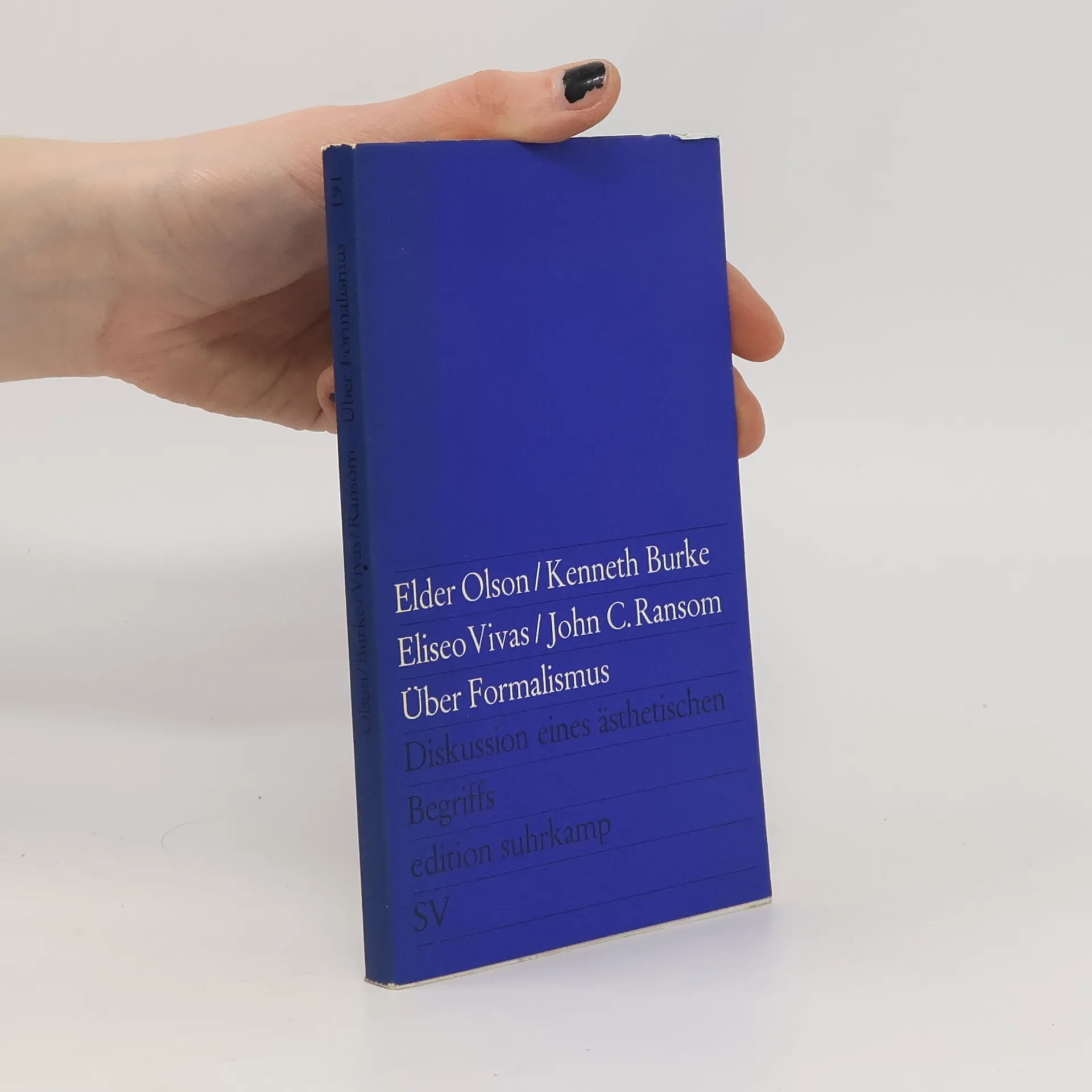
Über Formalismus Diskussion eines ästhetischen Begriffs
Diskussion eines ästhetischen Begriffs