

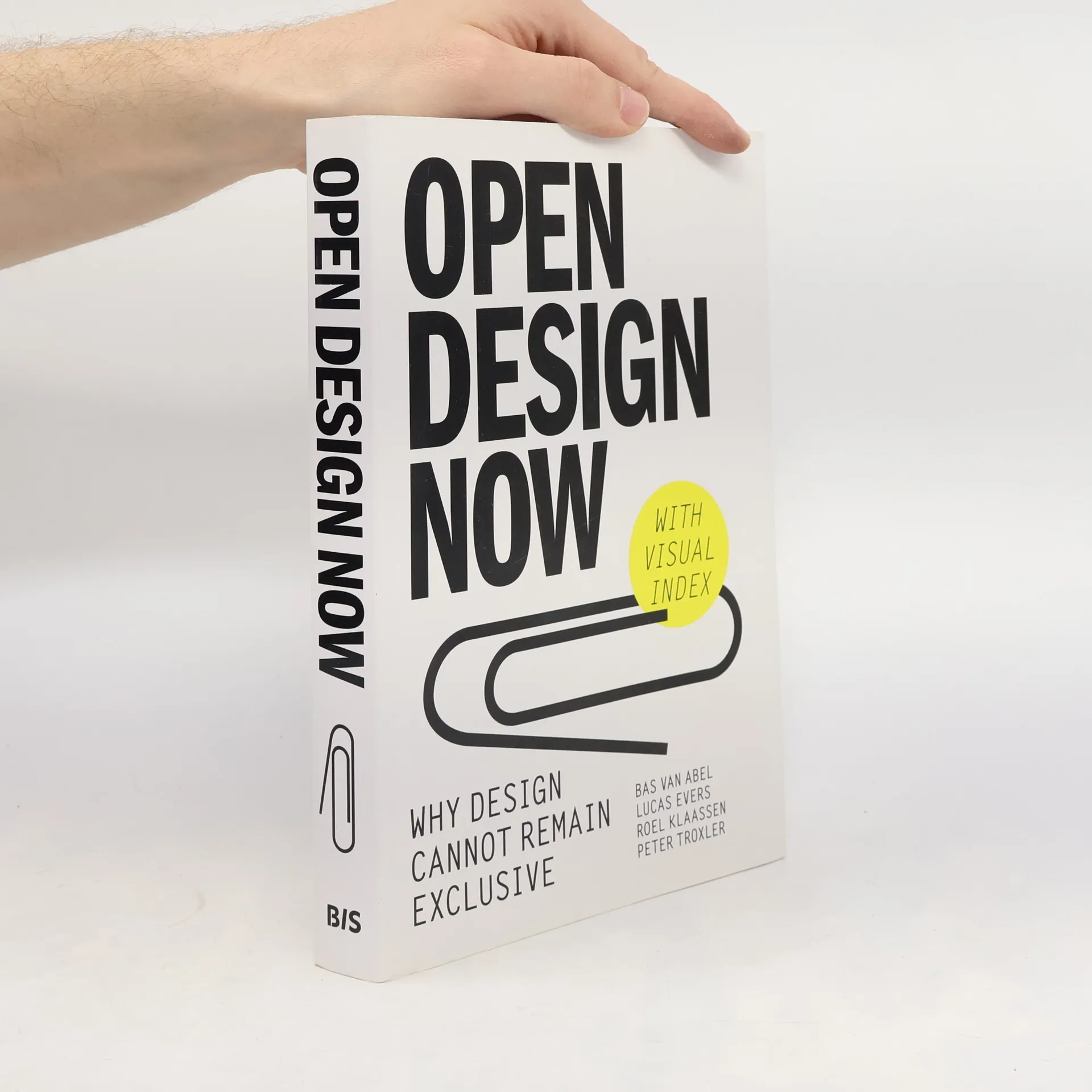
Open Design Now
Why Design Cannot Remain Exclusive
Parameters
- 256bladzijden
- 9 uur lezen
Meer over het boek
A multitude of articles - written by academics mostly centered around the industrial-design scene in the Netherlands - attempting definitions, describing challenges, opportunities and listing the tools, methodologies of the emerging field of Open Design. There is no consensus, especially in trying to define the field (what's included, what's not), and there is partially too much overlap in some of the articles (yes, the consumer turns into a pro-sumer, i get it now) but all in all the book, with its articles and additional short portraits, gives a great overview of the field (era 2011). Joost Smiers thought experiment stood out to me, where he theorizes that a complete abolishment of copyright laws would lead to a negative-feedback controlled market that wouldn't allow any blockbusters, any bestsellers to emerge and therefore even out the market to a more localized, fair system that would feed all artists and designers equally. One of the aspiring characteristics of Open Design - whether intentionally or not - is that it makes end-users (pro-sumers) assume more responsibility for their products/goods. And as we are facing scarcity of resources and nevertheless dispose of 50% of products within 3 months of buying (stats?), the books leaves one with the hope that the Open Design movement and all its cousins (Hacking, Recycling, Repairing, Sharing culture ..) might grip and help solve these problems.
Een boek kopen
Open Design Now, Bruce Mau, Paul Atkinson, Peter Troxler, Renny Ramakers, Michael Avital, Carolien Hummels, Roel Klaassen, Lucas Evers, Bas Van Abel
- Taal

- Jaar van publicatie
- 2011
- Bindwijze
- (Paperback)
Betaalmethoden
Nog niemand heeft beoordeeld.
- Titel
- Open Design Now
- Ondertitel
- Why Design Cannot Remain Exclusive
- Taal
- Engels
- Auteurs
- Bruce Mau, Paul Atkinson, Peter Troxler, Renny Ramakers, Michael Avital, Carolien Hummels, Roel Klaassen, Lucas Evers, Bas Van Abel
- Uitgever
- BIS Publishers bv
- Jaar van publicatie
- 2011
- Formaat
- Paperback
- Aantal pagina's
- 256
- ISBN10
- 9063692595
- ISBN13
- 9789063692599
- Reeks
- Tags
- Handel, Kunst, West-Europa, Grafisch Ontwerp, Casestudy
- Aantekening
- A multitude of articles - written by academics mostly centered around the industrial-design scene in the Netherlands - attempting definitions, describing challenges, opportunities and listing the tools, methodologies of the emerging field of Open Design. There is no consensus, especially in trying to define the field (what's included, what's not), and there is partially too much overlap in some of the articles (yes, the consumer turns into a pro-sumer, i get it now) but all in all the book, with its articles and additional short portraits, gives a great overview of the field (era 2011). Joost Smiers thought experiment stood out to me, where he theorizes that a complete abolishment of copyright laws would lead to a negative-feedback controlled market that wouldn't allow any blockbusters, any bestsellers to emerge and therefore even out the market to a more localized, fair system that would feed all artists and designers equally. One of the aspiring characteristics of Open Design - whether intentionally or not - is that it makes end-users (pro-sumers) assume more responsibility for their products/goods. And as we are facing scarcity of resources and nevertheless dispose of 50% of products within 3 months of buying (stats?), the books leaves one with the hope that the Open Design movement and all its cousins (Hacking, Recycling, Repairing, Sharing culture ..) might grip and help solve these problems.