Deze serie duikt in de methodologie van de sociale wetenschappen en biedt diepgaande inzichten in diverse analytische benaderingen. De focus ligt op de filosofische grondslagen van sociaal onderzoek, wat lezers een alomvattend overzicht biedt. Het is een essentiële bron voor iedereen die geïnteresseerd is in de nuances van sociaalwetenschappelijke bevraging. De reeks onderzoekt hoe vragen effectief geformuleerd en bevindingen geïnterpreteerd kunnen worden.
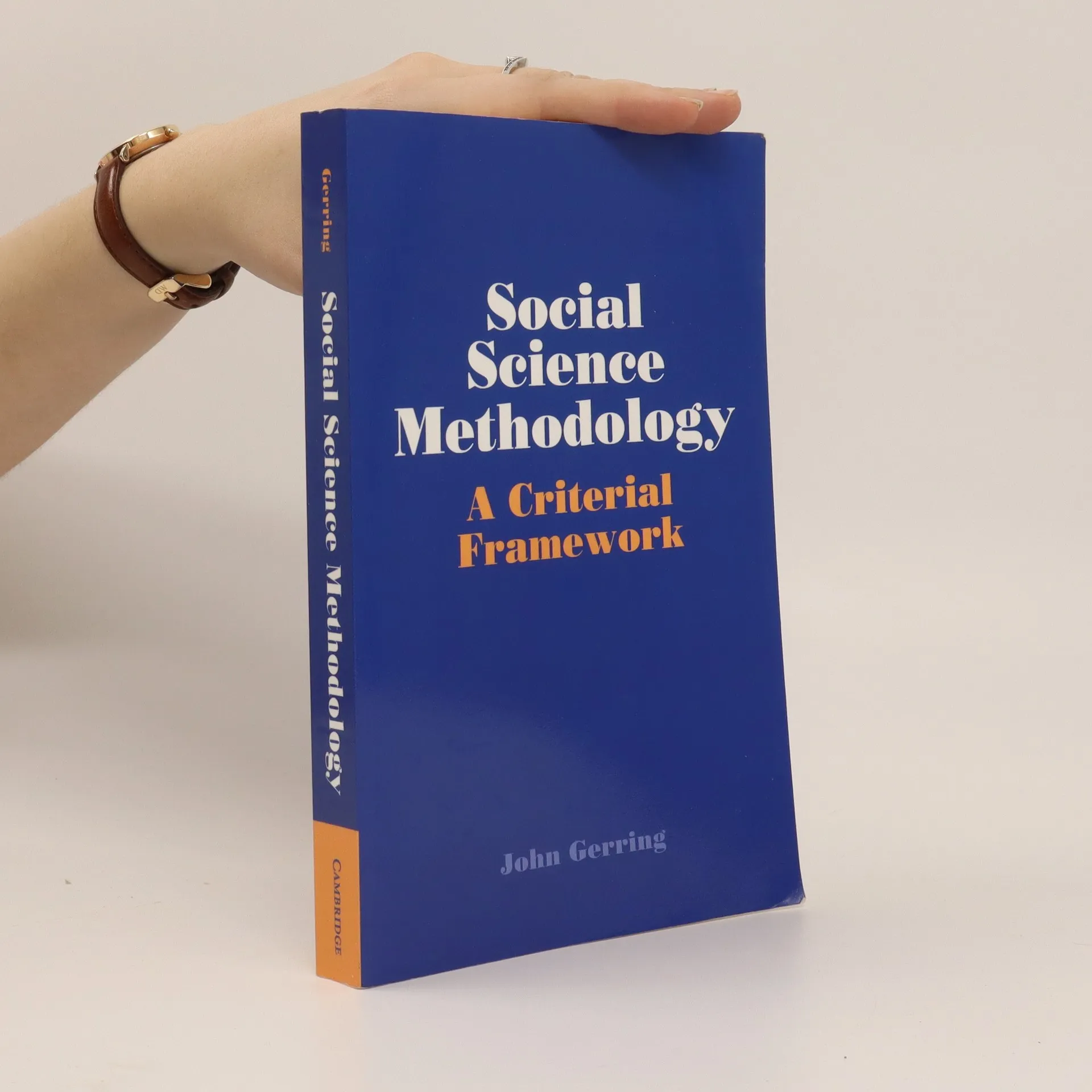
This book is an introduction to methodological issues in the social sciences that is appropriate for advanced undergraduates, graduate students, and general readers with some background in social science subjects. It is a concise and readable guide to doing and evaluating work in anthropology, economics, history, political science, psychology, and sociology.
Case Study Principles and Practices aims to provide a general understanding of the case study method as well as specific tools for its successful implementation. These tools can be utilized in all fields where the case study method is prominent, including business, anthropology, communications, economics, education, medicine, political science, social work, and sociology. Topics include the definition of a 'case study,' the strengths and weaknesses of this distinctive method, strategies for choosing cases, an experimental template for understanding research design, and the role of singular observations in case study research. It is argued that a diversity of approaches - experimental, observational, qualitative, quantitative, ethnographic - may be successfully integrated into case study research. This book breaks down traditional boundaries between qualitative and quantitative, experimental and nonexperimental, positivist and interpretivist.
This guide provides an in-depth exploration of Qualitative Comparative Analysis (QCA) and related set-theoretic methods used in social science research. It offers practical insights and techniques for researchers seeking to apply these methodologies effectively. The focus is on enhancing understanding of the complexities involved in comparative analysis, making it a valuable resource for both beginners and experienced scholars in the field.
Focusing on natural experiments, this comprehensive guide serves as an essential resource for scholars and students in the social sciences. It covers key issues in causal inference and highlights the significance of robust research design over intricate statistical methods. By emphasizing practical evaluation and application, the book aims to enhance understanding and execution of this increasingly popular methodology.