The Hegel Lectures Series, edited by Peter C. Hodgson, highlights the significant historical impact of Hegel's lectures, particularly those delivered in Berlin during the last decade of his life. Previous editions conflated materials, obscuring the development of Hegel's thought. This series is based on recently discovered transcripts and manuscripts, reconstructing lectures from specific years to clarify Hegel's arguments. Each volume features a new translation, editorial introduction, and annotations that identify Hegel's allusions and sources. The lectures on the Philosophy of Religion are crucial to Hegel's philosophical system, with variations in conception and execution across 1821, 1824, 1827, and 1831. Earlier editions created confusion by merging these materials into a single text. The current volumes present a critical edition, separating the lectures into independent units based on a thorough re-editing of sources by Walter Jaeschke. The English translation, recognized as definitive, is produced by Robert F. Brown, Peter C. Hodgson, and J. Michael Stewart, with assistance from H. S. Harris. The three volumes include editorial introductions, critical annotations, textual variants, tables, a bibliography, and a glossary. Hegel's 'Introduction' establishes the philosophy of religion as a new discipline, addressing philosophical, theological, cultural, and epistemological issues, while 'The Concept of Religion' offers

Georg Wilhelm Friedrich Hegel Boeken
Deze Duitse filosoof is een van de grondleggers van het Duitse idealisme. Beïnvloed door Kants transcendentaal idealisme en Rousseau's politiek, formuleerde hij een uitgebreid systeem van historische ontwikkeling van ethiek, bestuur en religie door de dialectische ontvouwing van het Absolute. Hij was een van de bekendste historicistische filosofen, en zijn denken liep vooruit op de continentale filosofie, inclusief het postmodernisme.


This new translation of The Science of Logic (also known as 'Greater Logic') includes the revised Book I (1832), Book II (1813), and Book III (1816). Recent research has given us a detailed picture of the process that led Hegel to his final conception of the System and of the place of the Logic within it. We now understand how and why Hegel distanced himself from Schelling, how radical this break with his early mentor was, and to what extent it entailed a return (but with a difference) to Fichte and Kant. In the introduction to the volume, George di Giovanni presents in synoptic form the results of recent scholarship on the subject, and, while recognizing the fault lines in Hegel's System that allow opposite interpretations, argues that the Logic marks the end of classical metaphysics. The translation is accompanied by a full apparatus of historical and explanatory notes.
Georg Wilhelm Friedrich Hegel gave many lectures in logic at Berlin University between 1818 and his untimely death in 1831. Edited posthumously by Hegel's son, Karl, these lectures were published in German in 2001 and now appear in English for the first time. Because they were delivered orally, Lectures on Logic is more approachable and colloquial than much of Hegel's formal philosophy. The lectures provide important insight into Hegel's science of logic, dialectical method, and symbolic logic. Clark Butler's smooth translation helps readers understand the rationality of Hegel's often dark and difficult thought. Readers at all levels will find a mature and particularly clear presentation of Hegel's systematic philosophical vision.
G. W. F. Hegel (1770–1831), the influential German philosopher, believed that human history was advancing spiritually and morally according to God’s purpose. At the beginning of this masterwork, Hegel writes: “What the history of Philosophy shows us is a succession of noble minds, a gallery of heroes of thought, who, by the power of Reason, have penetrated into the being of things, of nature and of spirit, into the Being of God, and have won for us by their labours the highest treasure, the treasure of reasoned knowledge.” In his introduction to this Bison Book edition, Frederick C. Beiser notes the complex and controversial history of Hegel’s text. He makes a case that this English-language translation by E. S. Haldane and Frances H. Simson is still the most reliable one.
"Originally published in 1840 as Geschichte der philosophie; Reprinted from the original 1896 translation published by Kegan Paul, Trench, Treeubner & Co., Ltd., London"--T.p. verso.
Lectures on the history of philosophy 2
- 453bladzijden
- 16 uur lezen
G. W. F. Hegel (1770–1831), the influential German philosopher, believed that human history was advancing spiritually and morally according to God's purpose. At the beginning of Lectures on the History of Philosophy, Hegel writes: "What the history of Philosophy shows us is a succession of noble minds, a gallery of heroes of thought, who, by the power of Reason, have penetrated into the being of things, of nature and of spirit, into the Being of God, and have won for us by their labours the highest treasure, the treasure of reasoned knowledge." Volume 2 of Lectures on the History of Philosophy, titled Plato and the Platonists for this Bison Books edition, introduces the most renowned disciple of Socrates and the theory of Platonic forms before moving to Plato's disciple, Aristotle, whose advance to scientific thinking is carefully detailed. The subsequent increasing systematization and sophistication of philosophy leads to a discussion of the Stoics, Epicureans, and Sceptics. The first period in the history of philosophy comes to maturity with Plotinus in the third century B.C.
This work brings together, for the first time in English translation, Hegel's journal publications from his years in Heidelberg (1816-18), writings which have been previously either untranslated or only partially translated into English. The Heidelberg years marked Hegel's return to university teaching and represented an important transition in his life and thought. The translated texts include his important reassessment of the works of the philosopher F. H. Jacobi, whose engagement with Spinozism, especially, was of decisive significance for the philosophical development of German Idealism. They also include his most influential writing about contemporary political events, his essay on the constitutional assembly in his native Württemberg, which was written against the background of the dramatic political and social changes occurring in post-Napoleonic Germany. The translators have provided an introduction and notes that offer a scholarly commentary on the philosophical and political background of Hegel's Heidelberg writings.
The phenomenology of mind
- 528bladzijden
- 19 uur lezen
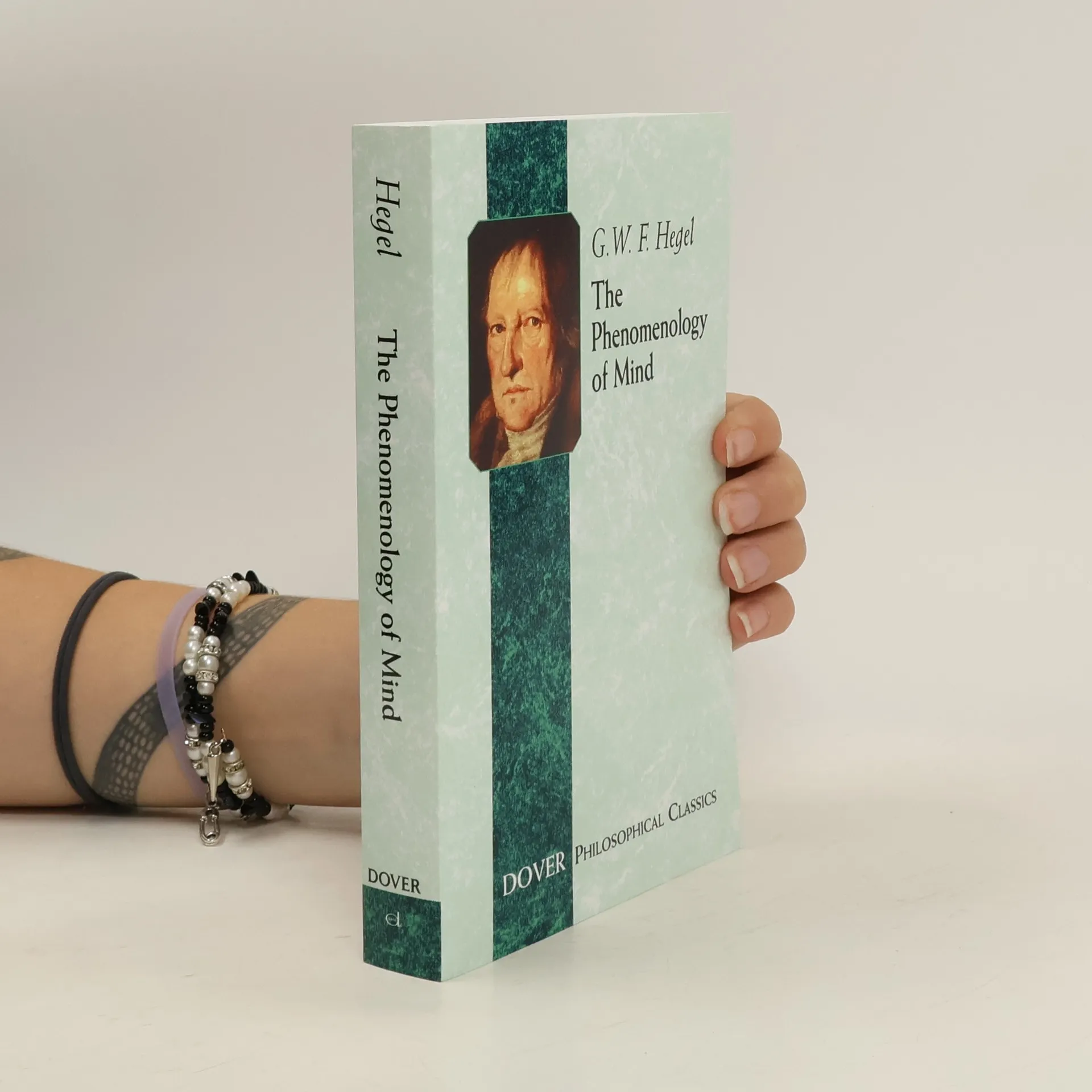
In The Phenomenology of Mind, idealist philosopher Georg Hegel (1770–1831) defied the traditional epistemological distinction of objective from subjective and developed his own dialectical alternative. Remarkable for the breadth and profundity of its philosophical insights, this work combines psychology, logic, moral philosophy, and history to form a comprehensive view that encompasses all forms of civilization. Its three divisions consist of the subjective mind (dealing with anthropology and psychology), the objective mind (concerning philosophical issues of law and morals), and the absolute mind (covering fine arts, religion, and philosophy).
We have reached the end of art, states Georg Wilhelm Friedrich Hegel in The Philosophy of Art. Hegel charts the progression of art in order to show how it reached its full and final development. But that does not mean that art is dead to us-far from it. Hegel argues for the significance of the philosophy of art, which for him ranks higher than the study of nature in terms of aiding our understanding of reality. Accompanying Hegel's overview of his science of aesthetics are a laudatory introduction by the prominent nineteenth-century scholar and translator W. Hastie and an extensive elaboration of Hegel's ideas by his student C. L. Michelet. Pt. I Hegel's introduction to the philosophy of art as the science of aesthetics -- Hegel's introduction on the nature, methods and division of aesthetics -- Definition of aesthetics, and refutation of objections -- The methods of scientific treatment -- Division of beautiful art as an organic whole -- Pt. II Michelet's philosophy of art as the science of aesthetics -- Introduction: aesthetics in general -- Formative art: architecture, sculpture, painting -- Musical art: music as art in tone -- Poetic art: poetry as art in speech.
The Philosophy of History
- 457bladzijden
- 16 uur lezen
Hegel wrote this classic as an introduction to a series of lectures on the "philosophy of history" — a novel concept in the early nineteenth century. With this work, he created the history of philosophy as a scientific study. He reveals philosophical theory as neither an accident nor an artificial construct, but as an exemplar of its age, fashioned by its antecedents and contemporary circumstances, and serving as a model for the future. The author himself appears to have regarded this book as a popular introduction to his philosophy as a whole, and it remains the most readable and accessible of all his philosophical writings. Eschewing the methods of original history (written during the period in question) and reflective history (written after the period has passed), Hegel embraces philosophic history, which employs a priori philosophical thought to interpret history as a rational process. Reason rules history, he asserts, through its infinite freedom (being self-sufficient, it depends on nothing beyond its own laws and conclusions) and power (through which it forms its own laws). Hegel argues that all of history is caused and guided by a rational process, and God's seemingly unknowable plan is rendered intelligible through philosophy. The notion that reason rules the world, he concludes, is both necessary to the practice of philosophic history and a conclusion drawn from that practice.