



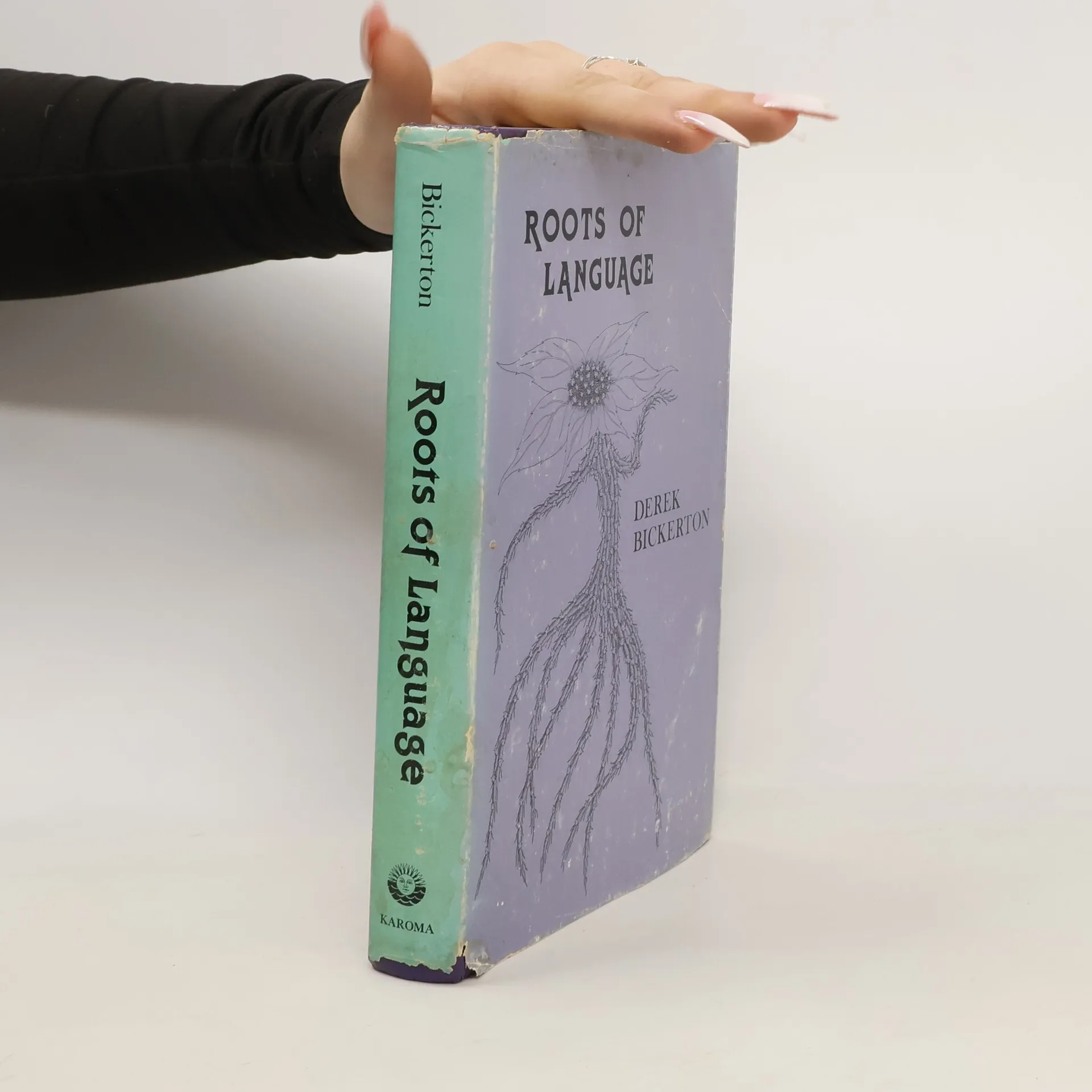
Roots of Language was originally published in 1981 by Karoma Press (Ann Arbor). It was the first work to systematically develop a theory first suggested by Coelho in the late nineteenth century: that the creation of creole languages somehow reflected universal properties of language. The book also proposed that the same set of properties would be found to emerge in normal first-language acquisition and must have emerged in the original evolution of language. These proposals, some of which were elaborated in an article in Behavioral and Brain Sciences (1984), were immediately controversial and gave rise to a great deal of subsequent research in creoles, much of it aimed at rebutting the theory. The book also served to legitimize and stimulate research in language evolution, a topic regarded as off-limits by linguists for over a century.
Derek Bickerton Boeken
Derek Bickerton was een taalkundige wiens werk over creoolse talen diepgaande inzichten bood in taalontwikkeling. Hij was een pionier van de bioprogramma-hypothese van taal, en suggereerde dat de universele overeenkomsten tussen creoolse talen voortkomen uit de manier waarop kinderen taal verwerven via een aangeboren, universele grammatica. Naast zijn academische bijdragen verkende Bickerton deze ideeën ook in zijn fictie, waarbij hij verhalen weefde die ingaan op de essentie van menselijke communicatie. Zijn geschriften belichten de fundamentele mechanismen die onze verbindingscapaciteit vormen.


William Calvin and Derek Bickerton suggest that other evolutionary developments, not directly related to language, allowed language to evolve in a way that eventually promoted a Chomskian syntax.
Language and Species
- 305bladzijden
- 11 uur lezen
Language and Species presents the most detailed and well-documented scenario to date of the origins of language. Drawing on "living linguistic fossils" such as "ape talk," the "two-word" stage of small children, and pidgin languages, and on recent discoveries in paleoanthropology, Bickerton shows how a primitive "protolanguage" could have offered Homo erectus a novel ecological niche. He goes on to demonstrate how this protolanguage could have developed into the languages we speak today."You are drawn into [Bickerton's] appreciation of the dominant role language plays not only in what we say, but in what we think and, therefore, what we are."—Robert Wright, New York Times Book Review"The evolution of language is a fascinating topic, and Bickerton's Language and Species is the best introduction we have."—John C. Marshall, Nature
Language and Human Behavior
- 190bladzijden
- 7 uur lezen
Bickerton challenges conventional views on human nature by asserting that language is not merely a communication tool but an evolutionary adaptation that shapes intelligence and consciousness. He argues that the unique properties of human thought derive from language, which originated as a representational system. By introducing the concept of protolanguage, he highlights how early hominids used symbols, lacking the ability to transform imagination into reality—an ability that distinguishes humans. This work is essential for those interested in the intersection of language, behavior, and evolution.
The City and the Desert: The Commandment Trilogy Part 3
- 314bladzijden
- 11 uur lezen
Set in fourth-century A.D. Egypt, the story follows Zachary, a failed hermit, and Leila, an ostracized nun, as they embark on a final journey together from the Nile valley. Their travels illuminate the complexities of early Christianity, exploring both its positive and negative aspects. As "casualties of life," their experiences reveal personal struggles against the backdrop of a transformative historical period.