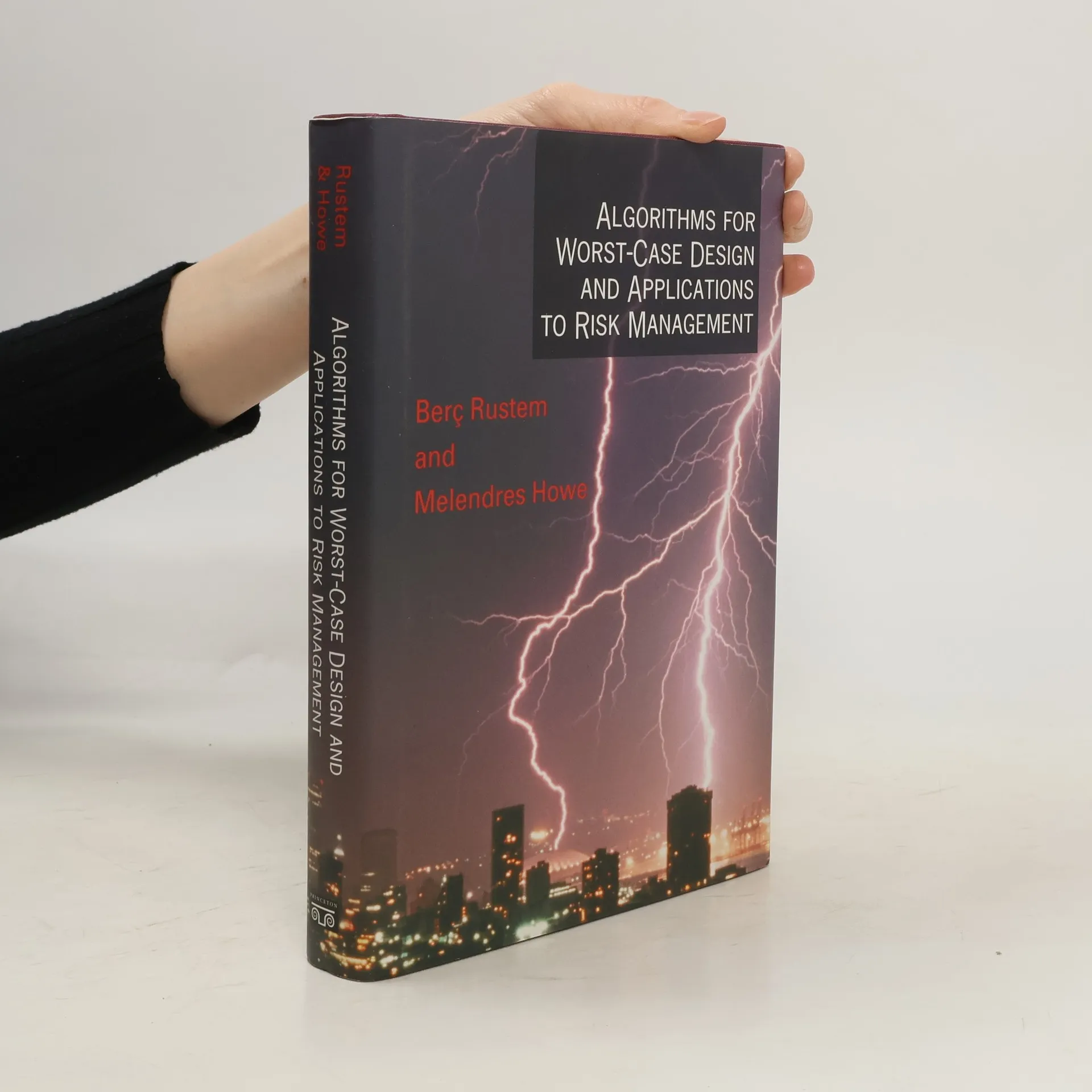
This book emphasizes the importance of robust decision-making in risk management, offering concepts and algorithms to determine the best decisions under worst-case scenarios. Utilizing the minimax approach, it ensures robust policies with optimal performance, which can improve if the worst-case does not occur. While the examples are primarily from finance, the algorithms and design principles are applicable across various fields, including economic policy and engineering. The discussion on worst-case design extends beyond extreme uncertainties, as identifying the worst case can be complex with numerous plausible rival scenarios. Optimality is assessed not on a single scenario but across all considered scenarios, ensuring guaranteed performance within the defined uncertainty range. The minimax solutions are noninferior and can yield multiple maxima, reinforcing their optimality. This approach does not aim to replace expected value optimization in stochastic uncertainties but rather complements it. Effective decision-making necessitates justifying policies based on expected values while considering worst-case scenarios. Additionally, the trade-off between the assured performance of robust decision-making and optimal expected values needs careful evaluation. Targeted at postgraduate students and researchers in optimization, engineering design, economics, and finance, this book is also a valuable resource for practitioners in r
Melendres Howe Boeken