



Daniel Cohen Volgorde van de boeken


- 2024
- 2022
Homo numericus
La ''civilisation'' qui vient
« L'auteur de La Prospérité du vice et d'autres best-sellers décrypte avec une joyeuse férocité cette prétendue « civilisation » qui bouleverse nos vies. L'amour ? Désormais, c'est Tinder ! Le bureau ? En télétravail ! Un nouveau job ? Ce sont les algorithmes qui recrutent ! Les partis politiques ? C'est sur Twitter ! Au centre de ce nouveau monde : Homo numericus, un être submergé de contradictions. Il veut tout contrôler, mais il est lui-même irrationnel et impulsif, poussé à des comportements addictifs par ces mêmes algorithmes qui surveillent les moindres détails de son existence. Faut-il désespérer ? Pas nécessairement. La révolution numérique est née des attentes d'une société qui rêvait de connaissances infinies, qui voulait que toute parole soit écoutée. Sans vérité révélée, affranchie des hiérarchies du passé. Trouver la voie qui permette d'accomplir cette utopie : telle est aussi l'ambition de ce livre.
- 2021
How populism is fueled by the demise of the industrial order and the emergence of a new digital society ruled by algorithms In the revolutionary excitement of the 1960s, young people around the world called for a radical shift away from the old industrial order, imagining a future of technological liberation and unfettered prosperity. Industrial society did collapse, and a digital economy has risen to take its place, yet many have been left feeling marginalized and deprived of the possibility of a better life. The Inglorious Years explores the many ways we have been let down by the rising tide of technology, showing how our new interconnectivity is not fulfilling its promise. In this revelatory book, economist Daniel Cohen describes how today's postindustrial society is transforming us all into sequences of data that can be manipulated by algorithms from anywhere on the planet. As yesterday's assembly line was replaced by working online, the leftist protests of the 1960s have given way to angry protests by the populist right. Cohen demonstrates how the digital economy creates the same mix of promises and disappointments as the old industrial order, and how it revives questions about society that are as relevant to us today as they were to the ancients. Brilliant and provocative, The Inglorious Years discusses what the new digital society holds in store for us, and reveals how can we once again regain control of our lives.
- 2020
Infinite Desire for Growth
- 184bladzijden
- 7 uur lezen
Why society’s expectation of economic growth is no longer realistic Economic growth—and the hope of better things to come—is the religion of the modern world. Yet its prospects have become bleak, with crashes following booms in an endless cycle. In the United States, eighty percent of the population has seen no increase in purchasing power over the last thirty years and the situation is not much better elsewhere. The Infinite Desire for Growth spotlights the obsession with wanting more, and the global tensions that have arisen as a result. Daniel Cohen provides a whirlwind tour of the history of economic growth, from the early days of civilization to modern times, underscoring what is so unsettling today. He examines how a future less dependent on material gain might be considered, and how, in a culture of competition, individual desires might be better attuned to the greater needs of society.
- 2016
Sozialer Ausgleich statt WachstumsdiktatAlle Anzeichen sind bereits da: Angst, Abschottung und Fremdenfeindlichkeit. Wenn wir keine Antworten auf die Frage finden, wie wir ohne Wirtschaftswachstum leben wollen, wird der Westen in Gewalt und Hoffnungslosigkeit versinken. Wir können nicht länger Sündenböcke suchen und unseren Wohlstand auf die Ärmsten der Gesellschaft gründen. Daniel Cohen, einer der führenden Ökonomen Europas und Experte für Staatsverschuldung, liefert eine brillante Analyse und wichtige Denkanstöße wie wir dem Wachstumsdilemma entkommen können.
- 2014
Hiram Bingham and the Dream of Gold
- 194bladzijden
- 7 uur lezen
The book presents a captivating portrayal of Hiram Bingham, an adventurous figure whose archaeological discoveries in the twentieth century mirror the exploits of a real-life Indiana Jones. It is designed to engage young readers with thrilling tales of exploration and discovery, highlighting Bingham's significant contributions to archaeology.
- 2014
Daniel Cohen has vividly reconstructed the life and times of Henry Stanley, the discoverer of the Nile's source, using Stanley's original newspaper reports and writings.
- 2012
Homo economicus, prophète (égaré) des temps nouveaux
- 212bladzijden
- 8 uur lezen
Sous l'égide d'une nouvelle civilisation-monde, dominée par un capitalisme exubérant, la société devient beaucoup plus compétitive. L'obsession des chiffres se diffuse et la manie du classement (écoles, hôpitaux, chercheurs, cadres, employés...) s'est installée partout. Sur Facebook, les enfants mettent leur vie privée en scène sous le regard et le jugement des autres, chacun cherchant à avoir le plus d'amis possibles. Les firmes organisent une concurrence nouvelle entre leurs salariés, sous-traitant les tâches inutiles, licenciant ceux qui ne peuvent pas suivre. Un monde néo-darwinien, où les plus faibles sont éliminés et soumis au mépris des vainqueurs, est en train de s'imposer. Adossé aux promesses ambigües de la révolution numérique en cours, un scénario crépusculaire se lit entre les lignes de ce monde en devenir. En y ajoutant les bouleversements rendus possibles par la génétique le défi est immense. Rien n'est pourtant inéluctable dans ces évolutions. Les métaphores tirées du monde naturel n'ont de pertinence que pour ceux qui en profitent. A l'heure où des milliards d'humains se pressent aux portes du modèle occidental, l'urgence est de repenser de fond en comble le rapport entre la quête d'un bonheur individuel - pas forcément inaccessible ! - et la marche efficace de nos sociétés modernes. Un nouvel essai provoquant qui nous rend plus intelligent.
- 2009
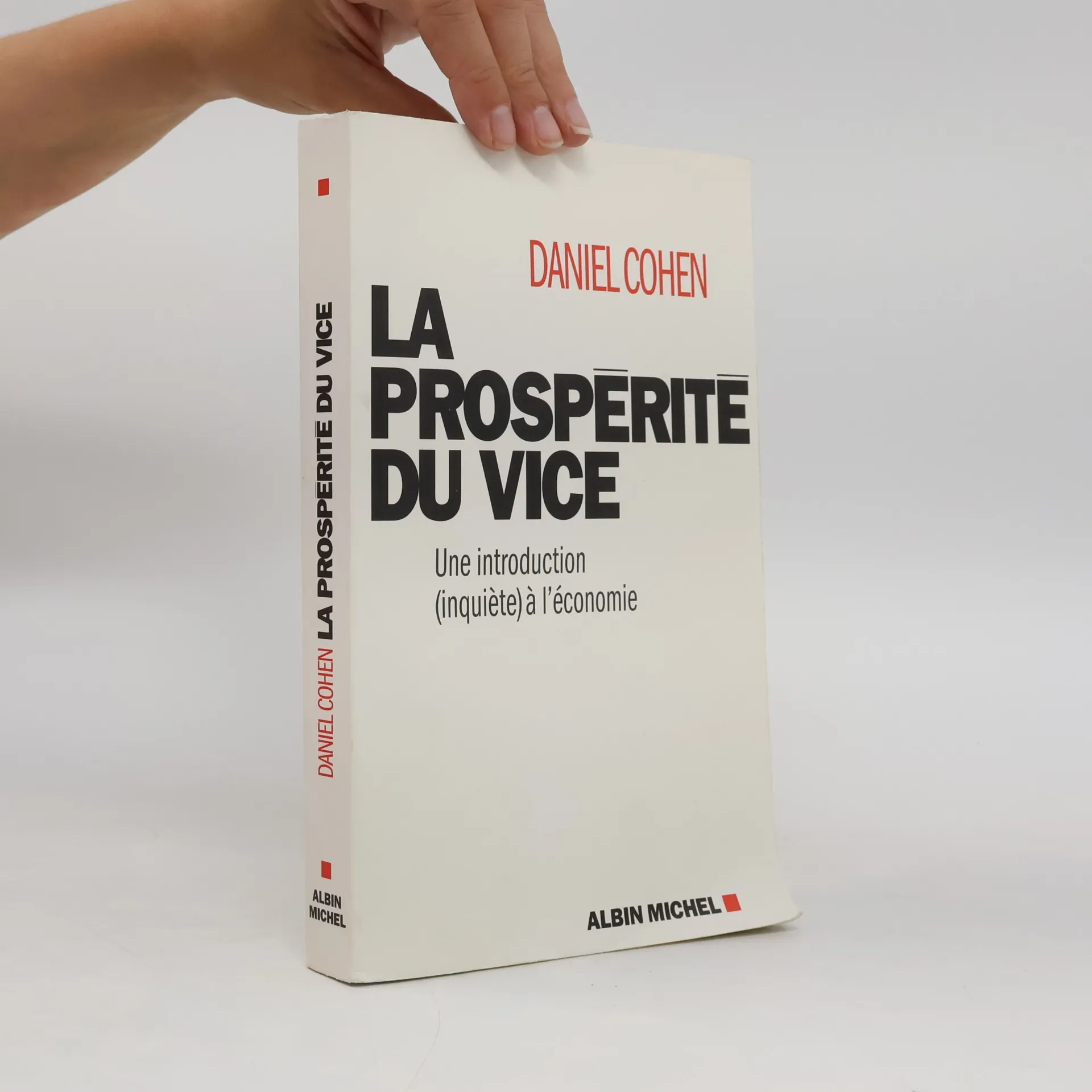
Are robust economic growth and tight social cohesion something of the past, or is contemporary stagnation simply part of a long economic cycle that is bound to bring brighter days? Should government step in to boost productivity and income, or does economic globalization necessitate a new laissez-faire model for the twenty-first century? The Prosperity of Vice elucidates the current debates on these and other questions in a fast-paced and incisive tour of the dominant ideas in political economy, summarizing historical and theoretical perspectives on the causes of economic growth in the United States, Western Europe, Japan and elsewhere as the twentieth century draws to a close. Daniel Cohen discusses the effects of the slowdown of productivity in Europe and the United States and explains the origin of the apparent trade-off between unemployment in Europe and wage inequalities in the United States. On questions of economic policy and the competing academic views (new classical and Keynesian) on the efficiency of government intervention, Cohen inverts the Keynesian belief that governmentintervention causes growth, and explains why waves of government interventions(including wars) usually follow upward economic trends (rather than create it). But he also advocates government discretion rather than government neutrality by showing the disastrous consequences of a hands-off approach to debt, inflation and social security.
- 2006
Der alte Menschheitstraum einer gerechten globalen Entwicklung von Wirtschaft, Gesellschaft und Staat steht im Mittelpunkt des Buches von Daniel Cohen. Der ausgezeichnete Ökonom wendet sich entschieden gegen Fatalismus und zeigt, unter welchen Bedingungen die Globalisierung sich zu einem langfristigen Friedensprojekt entwickeln kann. Die Rolle der Politik und die Notwendigkeit steigender Löhne als Voraussetzung für eine makroökonomische Wachstumsdynamik sind zentrale Aspekte seiner Analyse. Cohen belegt durch den Vergleich unterschiedlicher Entwicklungsstrategien, dass kapitalistisches Wirtschaften und internationaler Warenaustausch allein keinen Fortschritt und Wohlstand bringen. Eine menschenorientierte Globalisierungspolitik muss auf den Aufbau egalitär ausgerichteter Bildungs- und Sozialsysteme sowie auf die Entwicklung eines institutionellen Rahmens aus Menschenrechten, Demokratie und Rechtsstaatlichkeit hinarbeiten. Anhand umfassender Zahlen relativiert Cohen die wirtschaftliche Bedeutung des globalen Warenaustausches und betont, dass es auch im Zeitalter der Globalisierung die ureigenste Aufgabe eines jeden Staates ist, durch eine schlüssige Wirtschafts- und Finanzpolitik für das Wohl seiner Bürger zu sorgen.