

Meer over het boek
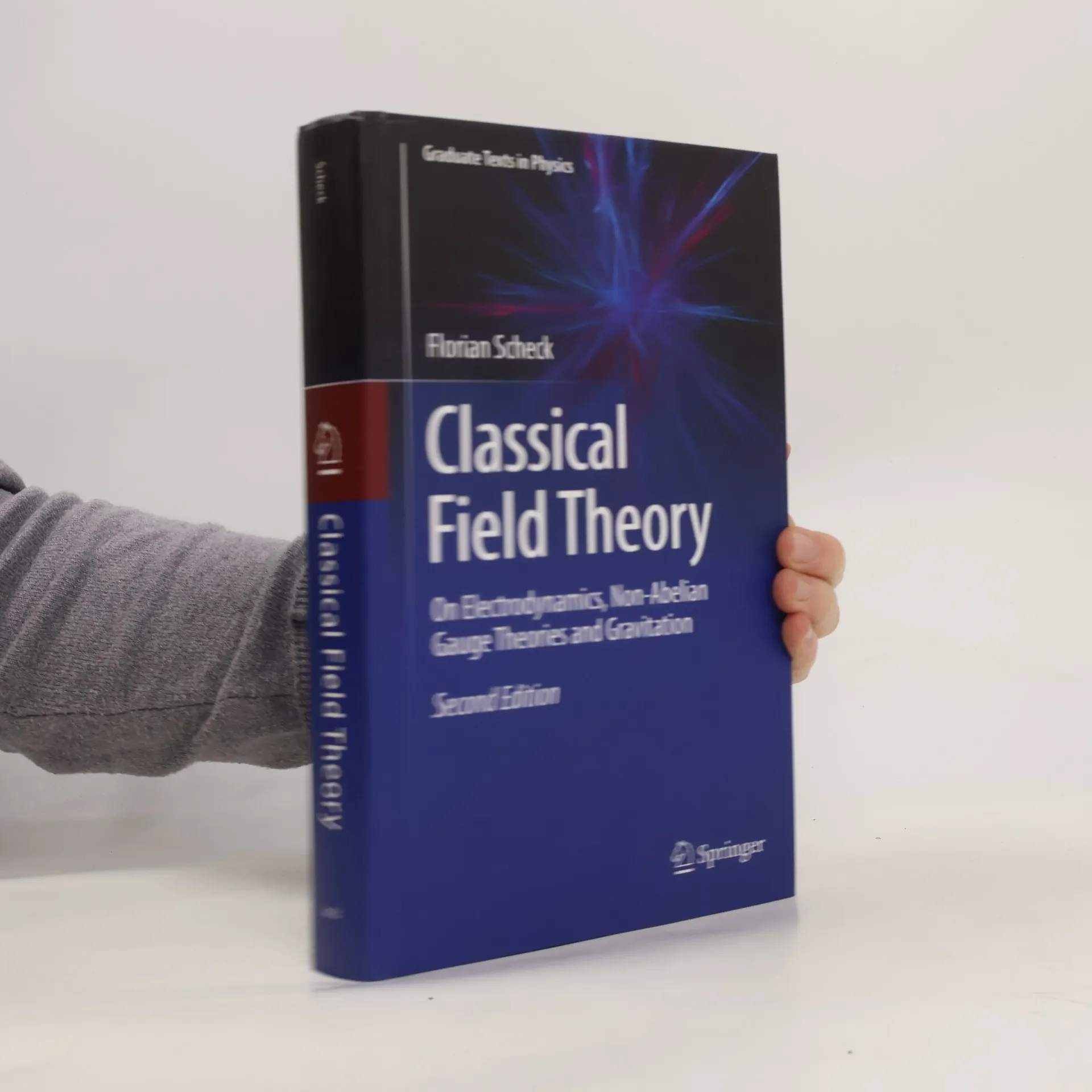
Scheck’s textbook offers a comprehensive treatment ideal for a one-semester course, beginning with Maxwell's equations in their integral form before transitioning to their local formulation. The initial chapters cover essential properties, including symmetries and covariance in modern notation. Chapter 3 focuses on Maxwell's theory as a classical field theory and explores solutions to the wave equation. Chapter 4 highlights significant applications, discussing topics like metamaterials with negative refraction and Helmholtz' equation solutions relevant to laser beam descriptions. Chapter 5 presents non-Abelian gauge theories from a classical, geometric perspective, using Maxwell's theory as a prototype, culminating in an application to the U(2) theory related to electroweak interactions. The final chapter summarizes semi-Riemannian geometry as the framework for gravitational field theory, concluding with the Schwarzschild solution and classical tests of general relativity. This edition introduces a dual-track approach: a fast track for master's students focusing on essentials and an intensive track for those seeking in-depth knowledge. Clearly labeled sections guide students through their preferred level of treatment, while numerous problems and worked examples facilitate successful engagement with Classical Field Theory.
Een boek kopen
Classical field theory, Florian Scheck
- Taal

- Jaar van publicatie
- 2018
- Bindwijze
- (Hardcover)
Betaalmethoden
Nog niemand heeft beoordeeld.
- Titel
- Classical field theory
- Ondertitel
- On Electrodynamics, Non-Abelian Gauge Theories and Gravitation
- Taal
- Engels
- Auteurs
- Florian Scheck
- Uitgever
- Springer
- Jaar van publicatie
- 2018
- Formaat
- Hardcover
- Aantal pagina's
- 464
- ISBN10
- 3662555778
- ISBN13
- 9783662555774
- Reeks
- Categorieën
- Aantekening
- Scheck’s textbook offers a comprehensive treatment ideal for a one-semester course, beginning with Maxwell's equations in their integral form before transitioning to their local formulation. The initial chapters cover essential properties, including symmetries and covariance in modern notation. Chapter 3 focuses on Maxwell's theory as a classical field theory and explores solutions to the wave equation. Chapter 4 highlights significant applications, discussing topics like metamaterials with negative refraction and Helmholtz' equation solutions relevant to laser beam descriptions. Chapter 5 presents non-Abelian gauge theories from a classical, geometric perspective, using Maxwell's theory as a prototype, culminating in an application to the U(2) theory related to electroweak interactions. The final chapter summarizes semi-Riemannian geometry as the framework for gravitational field theory, concluding with the Schwarzschild solution and classical tests of general relativity. This edition introduces a dual-track approach: a fast track for master's students focusing on essentials and an intensive track for those seeking in-depth knowledge. Clearly labeled sections guide students through their preferred level of treatment, while numerous problems and worked examples facilitate successful engagement with Classical Field Theory.