Bookbot

Gilbert Strang

    27 november 1934

    Deze Amerikaanse wiskundige staat bekend om zijn baanbrekende bijdragen aan de eindige-elemententheorie, de variatierekening, wavelet-analyse en lineaire algebra. Zijn toewijding aan wiskundeonderwijs blijkt uit zijn productieve output van zeven leerboeken en een monografie. Zijn colleges over inleidende lineaire algebra en computationele wetenschappen zijn gratis toegankelijk, wat zijn inzet benadrukt om wiskundige kennis breder toegankelijk te maken. Zijn werk toont consequent een diepgaand begrip van fundamentele concepten en een innovatieve aanpak om complexe uitdagingen aan te gaan.

    An Analysis of the Finite Element Method
    Calculus
    Computational Science and Engineering
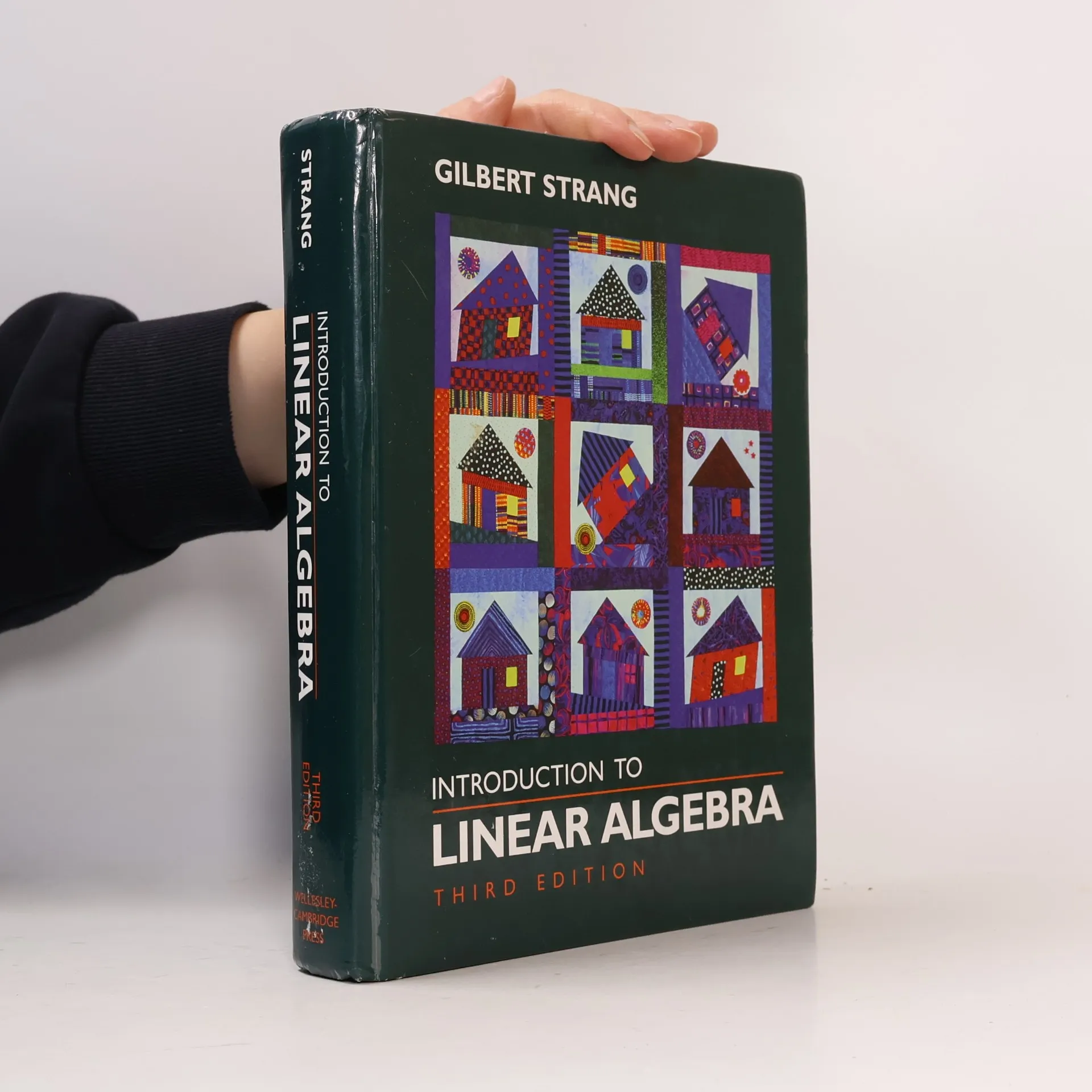
    Introduction to Linear Algebra
    Linear Algebra and Learning from Data
    Linear Algebra for Everyone
    • Linear Algebra for Everyone

      • 368bladzijden
      • 13 uur lezen

      Offering a fresh perspective on linear algebra, this book caters to learners of all levels, guiding them from fundamental concepts to advanced topics like singular value decomposition. Its accessible approach ensures that readers can grasp complex ideas easily, making it a valuable resource for students and enthusiasts alike.

      Linear Algebra for Everyone
      4,8
    • Linear Algebra and Learning from Data

      • 432bladzijden
      • 16 uur lezen

      Focusing on the intersection of linear algebra and deep learning, this textbook by Professor Gilbert Strang offers a comprehensive course that integrates essential mathematical concepts with practical applications in neural networks. It covers key topics such as the four fundamental subspaces, singular value decompositions, and optimization techniques, along with foundational elements of probability and statistics. The text is designed to be both accessible and rigorous, making it an invaluable resource for students eager to understand how linear algebra underpins modern data learning techniques.

      Linear Algebra and Learning from Data
      4,4
    • Introduction to Linear Algebra

      Third Edition

      • 568bladzijden
      • 20 uur lezen

      This informally written text provides students with a clear introduction into the subject of linear algebra. Topics covered include matrix multiplication, row reduction, matrix inverse, orthogonality and computation. The self-teaching book is loaded with examples and graphics and provides a wide array of probing problems, accompanying solutions, and a glossary. Chapter 1: Introduction to Vectors; Chapter 2: Solving Linear Equations; Chapter 3: Vector Spaces and Subspaces; Chapter 4: Orthogonality; Chapter 5: Determinants; Chapter 6: Eigenvalues and Eigenvectors; Chapter 7: Linear Transformations; Chapter 8: Applications; Chapter 9: Numerical Linear Algebra; Chapter 10: Complex Vectors and Matrices; Solutions to Selected Exercises; Final Exam. Matrix Factorizations. Conceptual Questions for Review. Glossary: A Dictionary for Linear Algebra Index Teaching Codes Linear Algebra in a Nutshell.

      Introduction to Linear Algebra
      4,4
    • Computational Science and Engineering

      • 750bladzijden
      • 27 uur lezen

      Covering the entire spectrum of computational science and engineering, this book delves into both modeling techniques and solution methods, including analytical and numerical approaches. It serves as a comprehensive resource for understanding the intricacies of computational methods and their applications in various scientific and engineering fields.

      Computational Science and Engineering
      4,0
    • Calculus

      • 500bladzijden
      • 18 uur lezen

      Gilbert Strang's clear, direct style and detailed, intensive explanations make this textbook ideal as both a course companion and for self-study. Single variable and multivariable calculus are covered in depth. Key examples of the application of calculus to areas such as physics, engineering and economics are included in order to enhance students' understanding. New to the third edition is a chapter on the 'Highlights of calculus', which accompanies the popular video lectures by the author on MIT's OpenCourseWare. These can be accessed from math.mit.edu/~gs.

      Calculus
    • Chapter 1: An Introduction to the Theory; Chapter 2: A Summary of the Theory; Chapter 3: Approximation; Chapter 4: Variational Crimes; Chapter 5: Stability; Chapter 6: Eigenvalue Problems; Chapter 7: Initial-Value Problems; Chapter 8: Singularities.

      An Analysis of the Finite Element Method